
Spinal Cord Injury Awareness Day: Lee's story
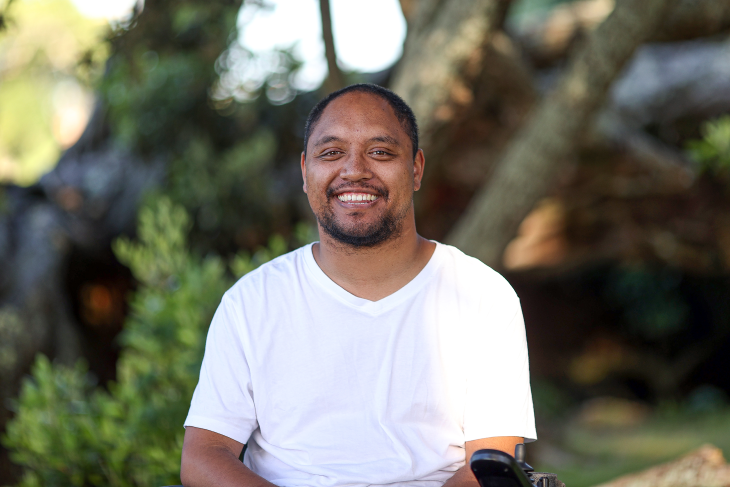
In 2009, Lee Taniwha went for a swim at his cousin's pool in Auckland. It was a hot summer day and he jumped in without thinking twice, resulting in a life changing injury. On Spinal Cord Injury Awareness Day, Lee is sharing his story to help others.





“Ma te tutu ka mohio, ma te mohio ka marama, ma te marama ka matatau, ma te matatau ka ora.”
[Through fiddling comes awareness, through awareness comes understanding, through understanding comes knowledge, and through knowledge comes wellbeing].
For Lee Taniwha, those words are more than a whakataukī. They describe the journey he has lived since a summer afternoon in South Auckland changed his life forever.
Lee was 13 when he jumped into his cousin’s swimming pool on a hot December day and misjudged the depth of the water. He broke his neck on impact.
For several terrifying minutes, he was trapped at the bottom of the pool, unable to move, counting the seconds he believed he had left.
“I was sure that was it, that I was going to die,” he says. “I was hanging on until my last breath.”
Emergency surgery saved his life. Screws were inserted into the base of his skull, and he was placed in an induced coma. After a month at Auckland Hospital, he spent five months at the Auckland Spinal Unit learning what life would look like with a high-level spinal injury.
When he left the Spinal Unit, Lee remembers being frightened.
“I was terrified,” he says. “I had no idea what life was going to be like in the outside world.”
That fear is an important part of Lee’s story because it’s the reality for many people who sustain a spinal cord injury.
A new normal
A spinal cord injury is not a single moment. It is the accident, the surgery and the early shock, but it is also everything that follows: learning new routines, accepting help, rebuilding confidence, and discovering that a meaningful life is still possible.
As a teenager, the Auckland Spinal Unit was challenging, physically and emotionally.
Lee talks about the tough love from nurses as he learned about bladder and bowel care, the humour that helped him through hard moments, and the humility that came with understanding his new reality.
Most of all, he remembers the people. He met others who were living with spinal cord injuries and saw, often for the first time, what his future could be.
They had careers, played sport, raised families and contributed to their communities. Their example changed his mindset.
“There’s nothing quite like talking with someone who understands what you are going through,” he says. “I remember thinking that things like having a career, doing sports and having a family were all still possible with a high-level spinal injury.”
Lee wants to share his story on Spinal Cord Injury Awareness Day, held on 5 September. The day is about recognising the challenges people face when they sustain spinal cord injuries, but it is also about prevention.
According to the New Zealand Spinal Cord Injury Registry (NZSCIR) there were 162 traumatic spinal cord injuries in 2025.
The Registry aims to record every new spinal cord injury (SCI) in New Zealand each year. Basic statistics are collected to help SCI services track how many people sustain a SCI, what the causes are (both because of an accident or illness), the severity and what treatments achieve better outcomes.
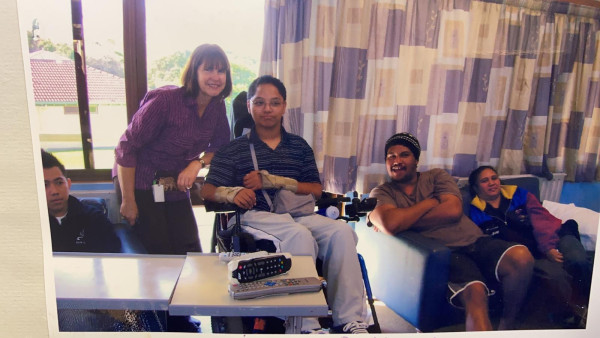
Lee at the Auckland Spinal Unit
A call to action
Lee’s story reminds us that one moment can have lifelong consequences, and that many serious injuries can be prevented if we pause to think about risk.
For Taniwha that message is deeply personal. He wants people, especially young people and their whānau, heading to pools, rivers and beaches, to take a moment before jumping in. Check the depth. Look for hazards. Do not dive headfirst into water you do not know. That brief pause could change everything.
This advice is supported by Maria Van den Heuvel, Charge Nurse Manager, Burwood Hospital: “Having fun in the water is something we all enjoy, but we need to be alert to hazards,” says Van den Heuvel.
“It pays to stop, pause, and think before you decide to dive headfirst into water - be it into a river, swimming pool or ocean - consider the depth, hidden rocks, shifting sandbars, and tidal changes over the course of the day.”
“While comprehensive rehabilitation is provided at New Zealand’s two Spinal Units - the best outcome is not to need our services in the first place.”
Lee is grateful for the support he has received from family, clinicians, carers, colleagues, and ACC throughout his recovery journey.
“That support has made a world of difference to my life,” says Lee.
Spinal Cord Injury Awareness Day is a call to action, he says.
“Awareness cannot end with sympathy - it must lead to understanding, knowledge and action.
“That might mean changing how we behave around water. It might mean talking to our children about risk. It might mean supporting someone with a spinal cord injury to live with dignity, independence and opportunity.
“We need to support everyone in our community to be the best version of themselves and promote diversity and inclusion.”