
NetballSmart: ‘Your greatest ability is your availability’
Former Silver Fern Jo Morrison is now passing on her netball knowledge to the next generation and says the ACC-funded NetballSmart programme is crucial to keeping young players on the court.





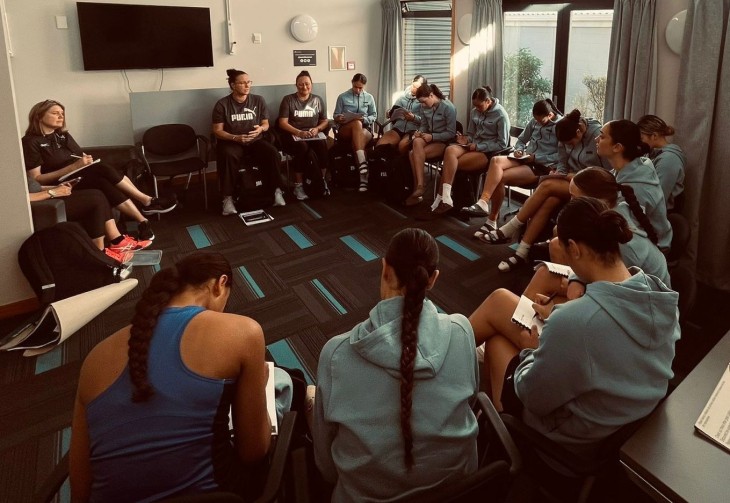
As coach of the New Zealand secondary schools netball team, Jo Morrison plays a key role in developing the nation’s future elite players.
But the former Silver Fern can only do that if those players stay on the court.
So she uses NetballSmart to improve performance and prevent injuries in her young players.
“Your greatest ability is your availability,” she explains.
“I didn't come up with that phrase, but I love it. If you’re doing all the right things and looking after yourself off the court, you’ll be available to us on the court.”
In 2025, ACC accepted over 23,700 netball-related injuries, which came at a cost of $51 million to help people recover.
NetballSmart, developed by ACC and Netball New Zealand, is a free resource with a range of strategies to help prepare players to take the court and decrease their injury risk.
It covers warm-up, cool down and recovery, skill and technique development, training load, wellbeing and injury management.
“As coaches, we want players that can consistently step up,” Jo says.
“Everyone can turn up to netball and have a good training session or game. But to do that consistently, you've got to be able to build your body, fuel it correctly, recover and go – and go again.”

Finding your athlete voice
It’s the little things you do away from training and games that contribute to big wins, Jo says.
“It’s about doing the basics and doing them well, consistently, repeatedly, and under pressure and fatigue,” she says.
“NetballSmart gives you all the big rocks – sleep, recovery, hydration and nutrition.”
One area Jo’s focused on as a coach is developing an athlete voice in her young players.
“It’s educating players about their load and what’s going to be best for them in the long-term,” she says.
“If you just keep saying yes to everything, you’ll get burnt out. An athlete voice is having the confidence to have those conversations with your coaches, parents or school, and all the other people who are influencing you.”
She believes this is particularly important in secondary school groups.
“They’re navigating so many things, juggling other sports practices, exams – you can't overload them.
“I try to be really clear in my communication and keep it simple. It’s a simple game, so you need to keep the language clear and concise.”
Providing a picture of physical capacity
Selection for the New Zealand secondary schools team starts with three development camps across the country in January.
NetballSmart plays a massive role in these camps, Jo says.
“We do what we call a warrant of fitness where each player completes strength testing and then performance benchmarking, which gives us an understanding of their aerobic capacity and jump strength.
“Everything is relatable to moving on court and gives us a really good picture of a player’s physical capacity.”
From the 90 athletes at camp, 24 are invited to attend trials in April. A team of 14 is then selected to travel across the Tasman to play the under-17 Australia side in July.
“It’s pretty cool for the players who get that experience and exposure, but we keep across what all the other players are doing in the secondary schools space.”
Removing barriers for our future Ferns
NetballSmart removes many of the barriers some young players face. It’s online, free and available to a wide audience.
“We know some of our best Silver Ferns have come from country schools and the little nooks and crannies of New Zealand,” Jo says.
“NetballSmart gives us the ability to educate all players and reach far beyond just the 90 that make the secondary schools camp.
“You don’t have to go to an expensive gym or school – you can access NetballSmart from anywhere and do it from wherever you may be.”
Jo says the success of the programme speaks for itself.
“We introduced the NetballSmart warm-up many years ago. Now, you can go to any netball centre in New Zealand and you'll see every team do it.
“The movements have become part and parcel of what you do.”
A study published by the British Medical Journal found teams performing this warm up at least twice a week had 37 per cent fewer training injuries and 29 per cent fewer game injuries. Severe injuries reduced by almost 50 per cent.
From small town life to the big stage
Jo grew up in Motueka, a small town at the top of the South Island.
Through the support of her family and coaches, she represented New Zealand at the highest level, making the Silver Ferns in 1997.
She has the distinction of competing at two Commonwealth Games for different countries, winning silver with New Zealand in 1998 and then gaining selection for England, her country of birth, for the 2002 edition.
She was fortunate to go through her whole playing career without sustaining many injuries. But it was an ankle injury that opened a pathway into coaching for her.
“An opportunity to be assistant coach with the Otago team came up and that was my first big opportunity to coach at that level,” she says.
“It kept me in the game through my injury. I went back and played after that, but that opportunity certainly gave me a taste for coaching.”
Educating players to take the next step
Jo has since coached a number of secondary school teams, worked as a development officer and in other specialist roles within netball, coached the Southern Blast and the Southern Steel, and was assistant coach for the New Zealand secondary schools side before taking on the head coaching role last year.
“I’ve been super lucky with all the opportunities I’ve had, but I’ve also worked really hard to refine my skillset and my understanding of the system,” she says.
“I think that's probably one of my strengths, I understand the system, so I work really hard at trying to educate the players on what it takes to take that next step, no matter what that level might be.”
Jo is based in Dunedin and balances her coaching role with relief teaching and coach facilitator roles with Netball South and Sport Otago, as well as being a mum to four sporty teenagers.
“It’s busy, but it fits in beautifully with what we’re trying to message to the players around self-management and being really well organised and having your time planned out.”
Improving performance and preventing injury
Funded by ACC, NetballSmart is the official injury prevention programme of Netball New Zealand.
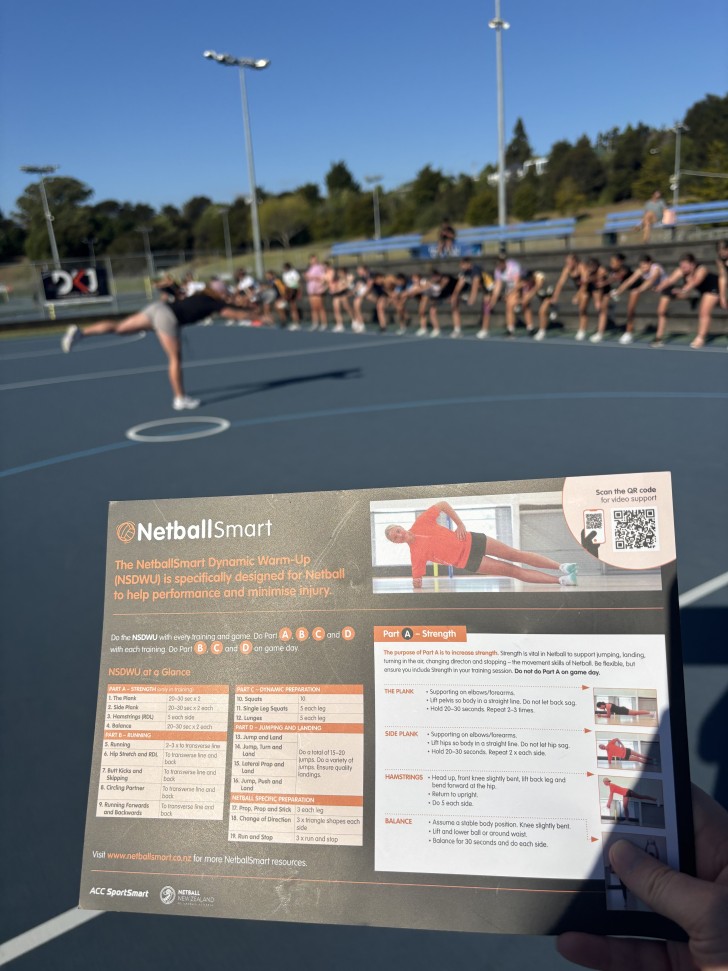
The NetballSmart dynamic warm-up is the official 15-20 minute warm-up for netball. It’s an evidence-based framework made up of six principles to help improve performance by preventing injuries:
Smart preparation – prepares the mind and body before you reach the court.
Dynamic warm-up, cool down and recovery – prepares you for the upcoming activity, cooling down prepares you for the rest of the day, while recovery prepares you for the next training session or game.
Smart movement – developing a player’s skill and technique correctly, which allows them to compete and enjoy their sport.
Smart training – ensuring the player’s body is prepared to play. This includes loading, endurance, strength, power and flexibility.
Smart player wellbeing/welfare – ensuring there’s a holistic awareness and approach to a player’s health and wellbeing.
Smart injury management – ensuring injuries are identified, assessed and reported early.
Netball injuries by the numbers
In 2025, ACC accepted 23,701 netball-related injuries, which came at a cost of $51 million to help people recover.
The region with the highest number of claims in 2025 was Auckland (8,072; $13.8m), Canterbury (2,955; $6.2m), Wellington (2,514; $5.6m), Waikato (2,385; $6m), Bay of Plenty (1,494; $3m) and Otago (1,249; $2.8m).
The age group with the highest number of injuries in 2025 was 10-14 years (6,514), followed by 15-19 years (4,803), 20-24 years (2,175), 25-29 years (2,164), 30-34 years (1,952) and 35-39 years (1,933).
Most injuries were soft tissue (20,976), followed by fracture/dislocation (1,565) and laceration/puncture/sting (374).
The most prevalent primary injury site was ankle (6,877), followed by knee (4,903) and finger/thumb (3,170).