
Alicia’s story: ‘I wasn’t going to let one part of my body stop me moving’
When Alicia Mabey suffered an injury to her Achilles, she was worried about looking after her young family and running her business. But a positive mindset and being active in her recovery soon helped Alicia get back to her best.





A small piece of pink plastic meant the world to Alicia Mabey.
It was a symbol of hope – that she would soon be able to return to an active lifestyle and enjoy doing the things she loves again.
“My husband very kindly bought me a new disc for disc golf and it was a really cool pink one,” she explains.
“So I wanted to get recovered – stronger and fitter – so I could get back out playing disc golf with my husband and children.
“When I threw it for the first time, it was an amazing feeling because I knew what my recovery had been like and the road to get to that point.”
Being active and playing sports is Alicia’s passion. But it was also what had put her out of action.
“I lunged for a ball playing squash and felt this ping,” she says.
“I spun around and was adamant my partner had hit me with her racket, because the noise and impact were like a shotgun. But then I collapsed to the ground and realised it was a snapped Achilles.”
Such injuries can need surgery and the recovery is long, taking six to 12 months.
That was bad news for Alicia, a busy mum of five who runs her own business in Timaru as a wellness and fitness coach.
“I knew I had to make the fastest recovery possible, given my business is physical, active work. In the past, I must admit I probably didn’t do all the exercises physios told me but, this time, I knew everything had to be done by the book,” she says.
“And for my mental health as well, I knew I had to keep moving my body. I wasn’t going to let one part of my body stop me moving totally.
“That’s what kept me positive and helped me recover as quickly as I did. I shifted the focus from what I couldn’t do to what I could do.”
Get back to what matters, sooner
ACC support provides boost to recovery
Even with that positive mindset, there were still some challenging times.
“Don’t get me wrong, it was hard. I couldn’t weight bear for about 12 weeks, it was tough not being able to put two feet on the ground,” Alicia says.
“Trying to keep my business afloat, juggling my own work and employees, was a worry of mine. My husband was working and I couldn’t drive so another huge worry was, how am I going to get our children from A to B?”
That’s where ACC stepped in and provided a welcome helping hand.
“They were able to support me and provide some payments to keep my business going, which brought a huge sense of relief,” she says.
“And they were also able to help with transport for the children, that was probably the biggest weight off my shoulders. That really eased my mind and helped me mentally get through parenting with an injury.”
ACC also arranged for someone to come into the family home and help with cleaning.
“It might not seem like much but I was on crutches so couldn’t carry anything or kneel, so having help around the house was huge.”
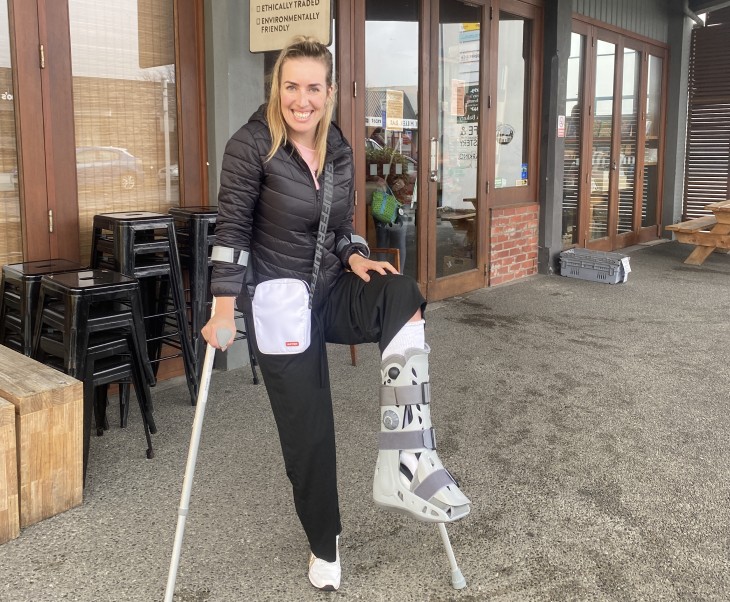
As her recovery progressed, ACC also provided a knee scooter, allowing Alicia to be more mobile.
“That support from ACC helped me, both mentally and physically, get through what turned out to be a long and challenging process. I couldn’t have recovered as well as I did without it.”
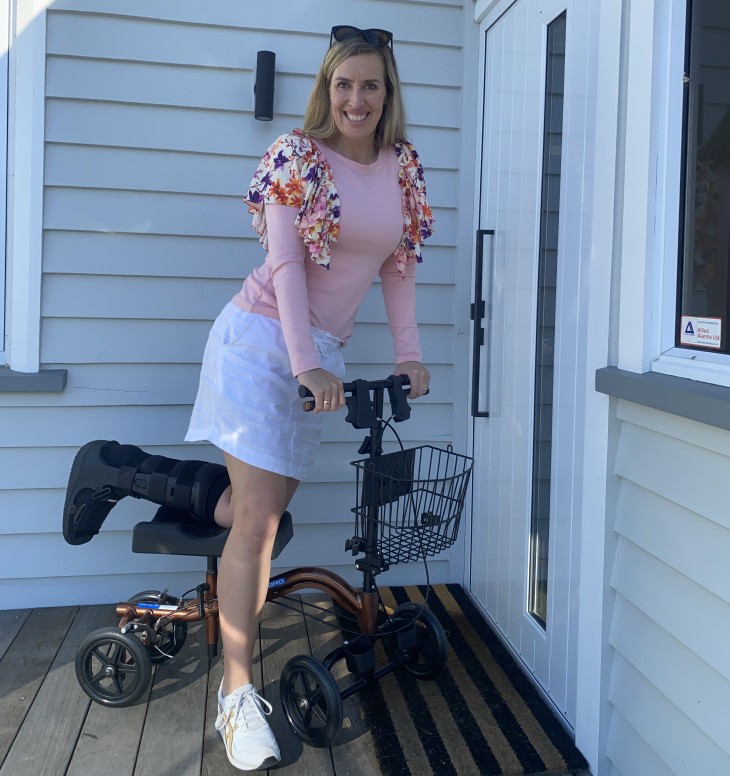
ACC provided a knee scooter to help Alicia get around.
‘Staying connected gave me motivation’
In addition to being active where possible and doing gentle movement, research shows staying connected to friends, family and the workplace can also help injured people get better, sooner.
A bubbly, warm person with a public-facing job, Alicia found keeping those connections going made a massive difference to her recovery.
“I’m used to being out in public and working with hundreds of people face-to-face every week, so I knew I couldn’t just sit at home and dwell on my injuries,” she says.
“There were days when I had a bit of a moan and was upset and gutted. But getting out with people and going along and watching my classes while another instructor was contracted to take them was huge.
“I found there’s a flow-on effect between staying connected, being interactive with people and then having the motivation to do my exercises.
“Having positive people around me gave me that drive to get better – it can be quite isolating and lonely by yourself and negative thoughts can sneak in.”
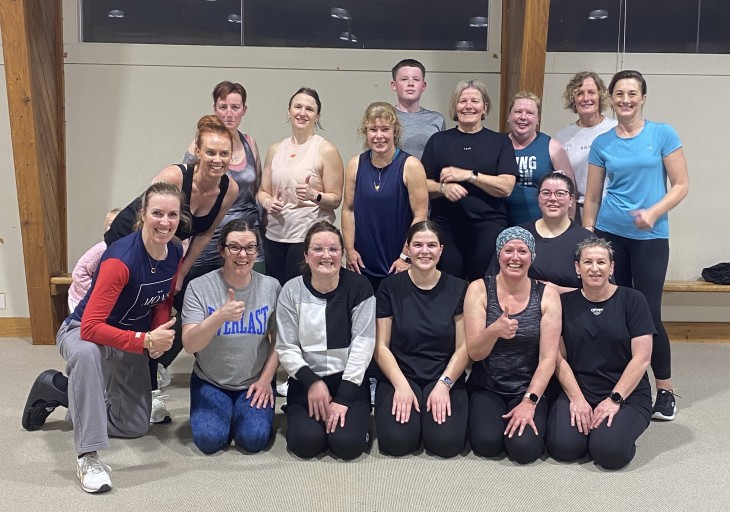
Alicia, front left, with some members of her fitness classes during her recovery.
Small steps lead to big gains
Alicia was also grateful for the guidance of an experienced physiotherapist, who understood her situation and the need to be back to her best as soon as possible.
“My physio was great, she knew my job was completely physical and that I needed my body to demonstrate and show people how to do exercises,” she says.
“And she comes from a sporting background herself, so she knew the power behind staying active and making sure you’re moving while you recover.
“Having a good physio who understands you, your goals and where you want to get to is really important.”
Alicia combined carrying out the exercises advised by her physio with home-based workouts that allowed her to strengthen her core without aggravating the injured Achilles.
“I thought to myself, if I don’t do these exercises, I’m going to lose all my strength and that’s going to play havoc down the line,” she says.
“So a huge driving force was seeing those small steps, the small increments eventually building up and knowing that I can start to slowly weight bear.
“And I had some big goals in mind, I wanted to be back running around with my kids, running my business and being independent again – that was my motivation.”
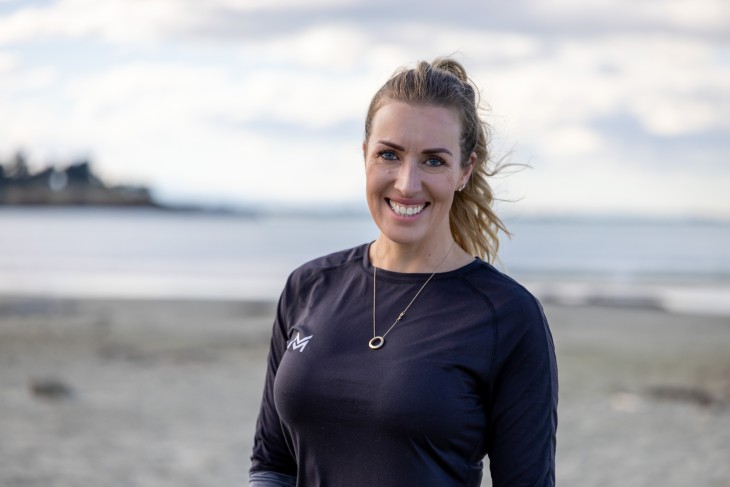
‘Don’t let it stop you in your tracks’
It’s now been nearly two years since Alicia suffered her injury and she’s been able to make a full recovery, including jumping and other explosive movements when leading exercise classes for her clients.
“I know that wouldn’t have happened if I didn’t put in the hard yards with my physio exercises and keeping my upper body strength,” she says.
Alicia has some wise words for others facing a long recovery journey from injury.
“As human beings, we all want to feel like were connecting and contributing,” she says.
“When it comes to an injury, we want to feel like we’re still connected, whether it’s to a local gym or your workplace. So don’t give up on those groups or organisations just because of an injury, you might just have to be a bit more clever in how you can still participate and be involved.
“You’ve got a choice on whether it stops you in your tracks or if you just divert and set your goals differently. Taking that approach has really helped in my recovery.”
Get back to what matters, sooner
Gentle movement and connection with others can help you recover from an injury faster, supporting both your body and mind.
Learn more on how an active recovery can help you get back to doing the things you love more quickly.