
CoverPlus Extra (CPX)
CoverPlus Extra (CPX) is optional cover that lets you to choose how much of your income you want to be covered if you have an accident and can’t work. We'll pay compensation based on your cover amount and option. You may also hear this cover referred to as CPX.
On this page
What is CoverPlus Extra (CPX)?
CPX is optional cover that allows you to agree on your cover amount before we invoice you. This means your cover will better match what it could cost you if you can’t work after an injury caused by an accident.
This type of cover may suit you if your income changes from year to year. It will mean you’ll know exactly how much cover you have and what you will be invoiced for. It may also suit you if you’re newly self-employed and don’t have an earnings history yet but still want more certainty about your cover.
Who can apply for CPX?
You can apply for CPX if you are:
- self-employed or a non-PAYE shareholder, ie you don’t receive PAYE deducted earnings from your company
- filing ACC liable income
- working full-time (more than 30 hours per week on average)
- working part-time (30 hours or less per week on average) and have earnings above the CPX minimum for the current year.
If you are working part-time and earn less than the CPX minimum, you are not eligible to apply for CPX.
Benefits of CPX
- No surprises at invoice time. Your levy invoices are predictable, as we calculate them by using the cover amount agreed with us.
- Knowing exactly how much you’ll receive in weekly compensation if you get injured.
- Weekly compensation is paid at 100% before tax.
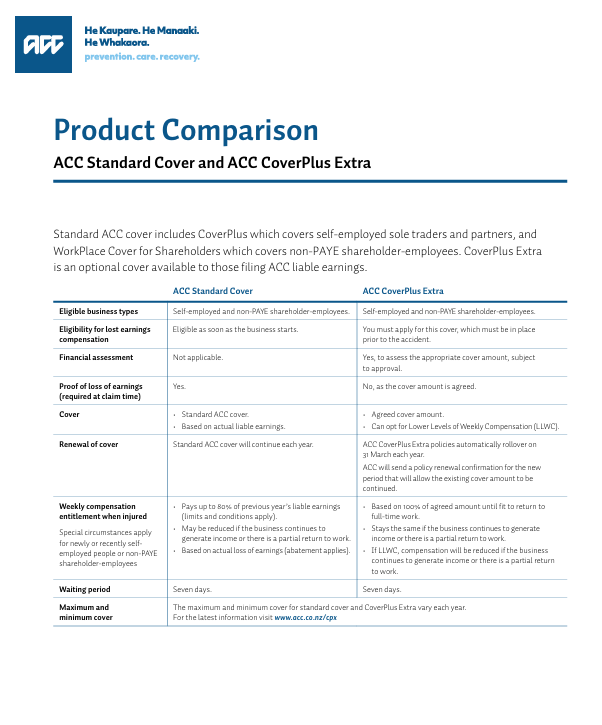
Product comparison | CoverPlus and CoverPlus Extra
Download our compassion guide to see side-by-side the differences.
How to apply for CPX
To apply for CPX you will need to have an account for MyACC for Business.
If you already have an ACC number, you can log in and do this online.
If you don’t have an MyACC for Business log in, you can complete an online form to request one | Request an ACC number for your new business account
Once you’ve applied, you must accept the offer letter which will be sent to you. At this stage your CPX policy comes into effect. In some instances, we may need to contact you about your application before sending you an offer letter.
How to choose the right cover amount for you?
As the purpose of CPX is to provide a cover amount that fairly reflects your likely costs of incapacity, you may be asked to supply financial documentation for some cover amounts if it is higher than your current earnings.
- You can request your own cover amount between the CPX minimum and CPX maximum. These figures change each year. For the 2026/27 year the minimum is $40,401.00 and the maximum is $125,313.00.
- We recommend speaking with a financial advisor if you need help selecting the right cover amount for you.
CPX options
When you apply you can select from ‘lower levels of weekly compensation’ or ‘full compensation’.
Lower levels of weekly compensation
In return for a slightly lower levy, this option provides weekly compensation payments which reduce when returning to part-time work or if your business continues to generate income. For example, if your cover is $52,000 per year, we’ll pay 100% of this amount (before tax) until you return to part-time work or if your business continues to generate income. If you return to work for 50% of your normal hours or continue generating 50% of your income, your payments will reduce by 50%. Payments stop once you are no longer incapacitated.
Full compensation
With this option, we’ll pay 100% of the agreed cover (before tax), divided into weekly payments until you are no longer incapacitated. For example, if your cover is for $52,000 a year, we’ll pay 100% of that amount each week, which is $1,000 (before tax).
Note for part time earners:
- if you are part time (working 30 hours or less) you must select Full Compensation cover in your application.
Classification Unit’s
On the CPX application you will be asked to select the correct Classification Unit (CU) for your line of work. We may need to contact you to confirm some details about your day-to-day work activities.
When selecting your CU it needs to align with what you or your company does to generate its income and or match what services you offer to your clients.
For help with selecting the correct Classification Unit or for more information visit Business Industry Classification Code

How will you be invoiced?
- You’ll receive an invoice soon after you have accepted your offer letter. If you are starting the new levy year with a CPX policy, then you will be invoiced in April.
- It’s important that you pay your invoice by the due date on the invoice, otherwise your policy will be terminated. This, as well as other conditions of the policy are outlined in the terms and conditions.
Download | CoverPlus Extra terms and conditions
Learn more about our payment options for your invoice - Ways to pay levies
Making changes to my CPX policy
It is important that you let us know if any of your details change during the policy period. You can make changes to your policy yourself via MyACC for Business, some changes can be made immediately with no delay, while others may require us to contact you. Login to MyACC for Business
Changes you need to let us know about include:
- the way you file your income
- your address or other contact details
- your earnings significantly change and you now earn under the CPX minimum
- your employment status
- any other material change that will impact your policy.
If you can’t inform us of these changes in MyACC for Business, contact us
Phone 0800 222 776
Email cpx@acc.co.nz
If you have contacted us to update your policy details and are waiting to hear from us, your invoice must still be paid by the due date. A reassessed invoice will be generated if applicable once updates have been processed.
Please note, these are subject to manual processing times and may take longer than making the changes yourself via MyACC for Business.
CPX renewals
- In March each year you will be sent a renewal letter confirming your cover details for the next financial year. If you believe anything needs to be updated, you can update any details via MyACC for Business
MyACC for Business - manage your account and levies online - As part of your renewal letter, you will also be sent updated terms and conditions.
- You must ensure that any requested changes are submitted in time for them to apply for the full financial year.
The CPX minimum and maximum cover amounts increase slightly each year. Please ensure that the cover amount you are on or requesting supports your upcoming financial year.
- If you are currently on the CPX minimum cover amount, this will automatically update to the minimum for the new financial year.
- If you are currently on the CPX maximum cover amount, you will need to request to increase to the new maximum if you would like to be covered by the new amount.
How we will contact you
If we need to contact you about your application we will contact you via phone or email. We will send documentation such as invoices via your preferred correspondence preference. You can update your correspondence preference via MyACC for Business. We encourage customers to use email as their preference for a quicker and more reliable service.
If you have post as your correspondence preference, please be aware that communications will take longer to get to you. If you don’t receive an invoice that we have posted and as a result you miss a due date, we will not reinstate your policy.
Regardless of correspondence preference, if there is a verified email address on file, we will send all payment reminders to the email address. Please ensure you check your junk mail too.
If you're turning 65 or have recently turned 65
If you receive NZ Superannuation (or equivalent), you don’t have to cancel your CPX policy. If you’re still filing liable income above the CPX minimum, you’re eligible for CPX cover. If you get injured, you’ll receive weekly compensation payments as well as NZ Superannuation.
However, weekly compensation payments are limited to a two-year maximum per claim from when your compensation payments start. If you have a long-term injury, your weekly compensation payments will stop after two years, and you will only receive NZ Superannuation payments.
Example 1: John is 66, still on an eligible CPX policy, and they are off work due to an injury for three months. John will receive weekly compensation payments as well as NZ Superannuation.
Example 2: Yvonne is 70 but hasn't worked since June 2025 due to an injury. Yvonne's weekly compensation payments will stop in June 2027, but their NZ Superannuation payments will continue.
Example 3: Lua is 65 still on an eligible CPX policy. Lua is off work for three months due to an injury. Lua will receive weekly compensation payments as well as NZ Superannuation. Lua then has another injury four months later and requires weekly compensation again. Lua can receive up to two years of weekly compensation for that claim before it stops and NZ Superannuation payments will continue.
For more information, please visit the New Zealand Superannuation and the Veteran’s Pension page.
Contact us
If you have any questions or want to know more, contact us:
Email cpx@acc.co.nz
Phone 0800 222 776 (Monday to Friday, 8am to 6pm)
Phone (from overseas) +64 7 859 8675
Last published: 27 July 2026