
Guidelines for returning to work after surgery
We’ve collaborated with the New Zealand Orthopaedic Association (NZOA) to develop evidence-based guidelines that provide clear expectations for recovery and return to work following elective surgery. These guidelines were developed using international evidence and expert clinical consensus from NZOA specialty societies.
On this page
The purpose of the guidelines
The guidelines are for the following surgeries:
- ACL reconstruction
- ankle lateral ligament reconstruction
- knee arthroscopy
- lumbar discectomy
- lumbar fusion
- rotator cuff repair
- total or partial knee replacement.
The guidelines are intended to be used by surgeons to support their certification practices and conversations with patients about their recovery to help them get back to work and independence sooner.
There is strong evidence that work is generally good for physical and mental health and wellbeing. Work can be a valuable component of a patient’s rehabilitation. It can keep them socially connected while maintaining their income and overall confidence. It can also provide useful physical activity and a sense of purpose, which all contribute to a better recovery.
A safe and timely return to work not only benefits the patient, but also their whānau and their workplace.
Return-to-work guidelines
These guidelines were developed in collaboration with the New Zealand Orthopaedic Association (NZOA).
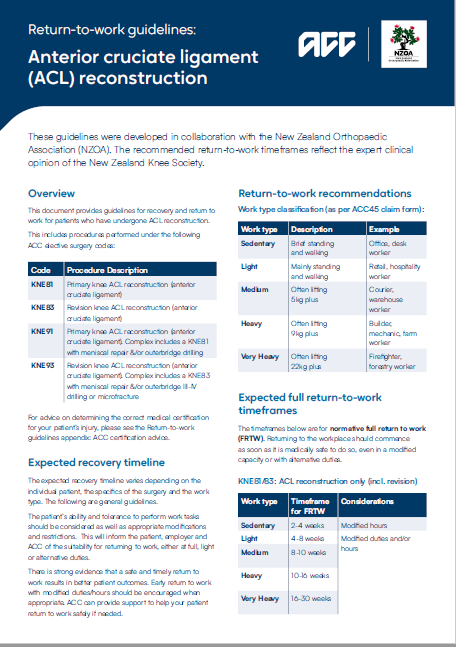
ACL reconstruction
The recommended return-to-work timeframes reflect the expert clinical opinion of the New Zealand Knee Society.
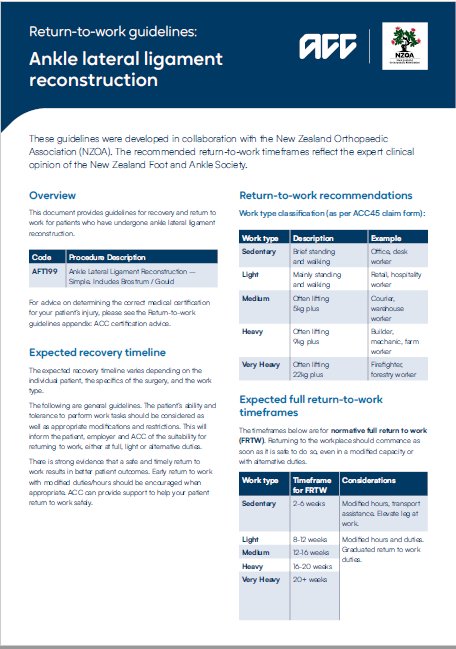
Ankle lateral ligament reconstruction
The recommended return-to-work timeframes reflect the expert clinical opinion of the New Zealand Foot and Ankle Society.
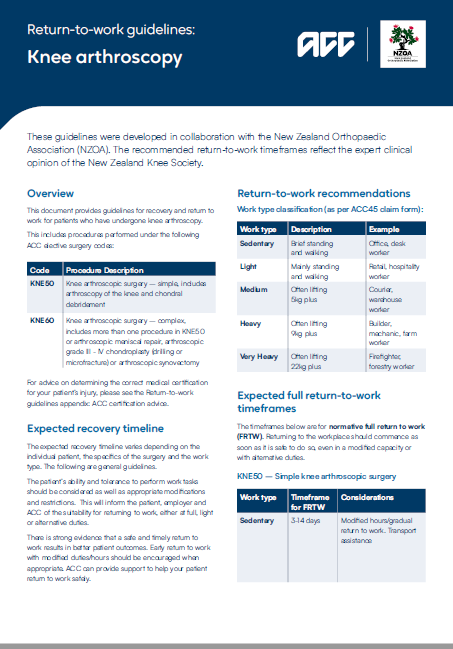
Knee arthroscopy
The recommended return-to-work timeframes reflect the expert clinical opinion of the New Zealand Knee Society.
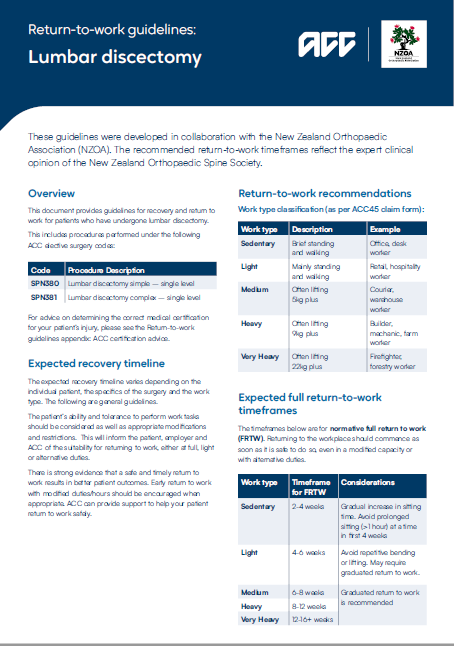
Lumbar discectomy
The recommended return-to-work timeframes reflect the expert clinical opinion of the New Zealand Orthopaedic Spine Society.
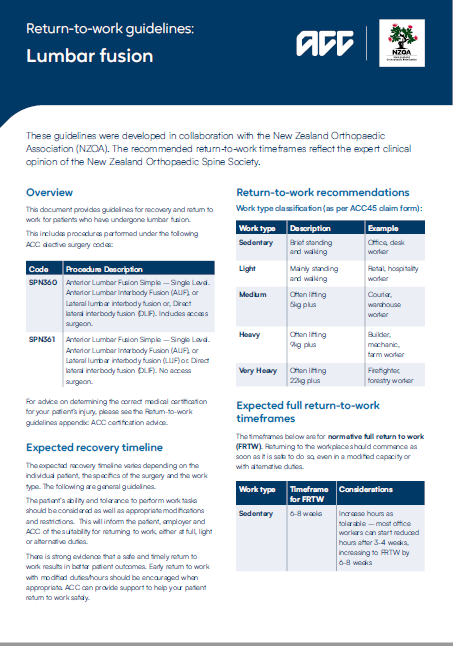
Lumbar fusion
The recommended return-to-work timeframes reflect the expert clinical opinion of the New Zealand Orthopaedic Spine Society.
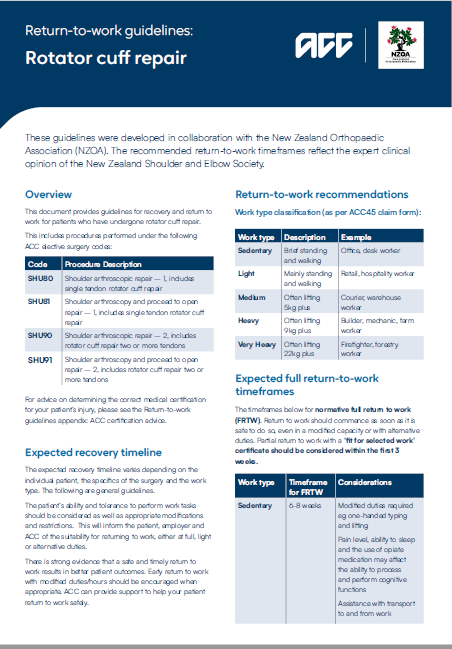
Rotator cuff repair
The recommended return-to-work timeframes reflect the expert clinical opinion of the New Zealand Shoulder and Elbow Society.
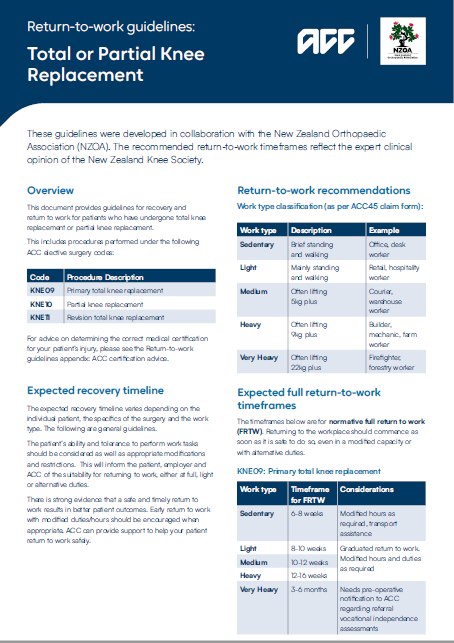
Total or partial knee replacement
The recommended return-to-work timeframes reflect the expert clinical opinion of the New Zealand Knee Society.
Guidance for issuing medical certificates
Issuing the correct medical certificate for your patient’s injury plays an important role in their recovery.
You can certify your patient as either ‘fit for selected work’, ‘fully unfit’ or ‘fully fit’. With the ‘fit for selected work’ and ‘fully unfit’ certifications, your patient will be eligible for weekly compensation from us. This is provided they were earning at the time of their accident.
If your patient was unemployed at the time of the accident, they are not eligible for weekly compensation.
It’s important to review the patient regularly to ensure they can return to work as soon as medically safe. For advice on how to issue the correct medical certificate for your patient’s injury, see our 'Return-to-work guidelines appendix: ACC certification advice'.
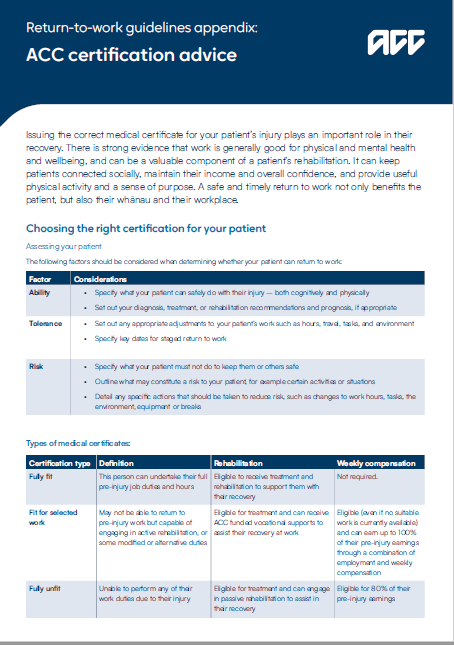
Return-to-work guidelines appendix: ACC certification advice
This document provides advice on how to issue the correct medical certificate for your patient’s injury,
Last published: 13 April 2026