
Weekly compensation for employees
Learn when to expect your first payment, and how payments might change over time.
If there are changes to your income or work situation while receiving weekly compensation, please let us know straight away. This includes starting or leaving a job, adjusting hours, taking leave, receiving holiday pay, a pay increase, or income-related benefits.
On this page
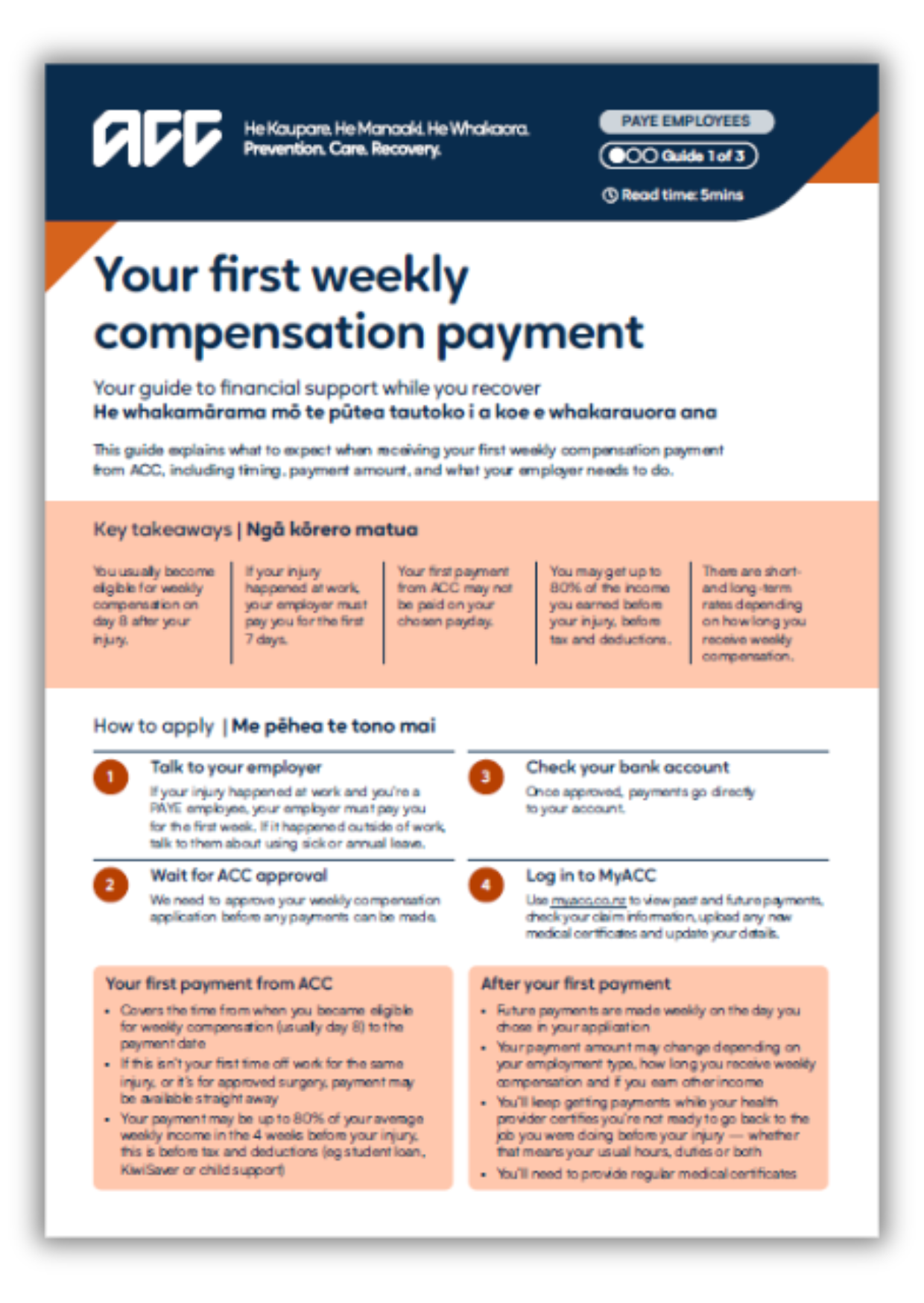
Your first weekly compensation payment - for PAYE employees
This guide is for PAYE employees, it explains what to expect when receiving your first weekly compensation payment from ACC, and what you and your employer need to do. Download, print or share this guide with whānau and friends.
Video | What to expect from your first weekly compensation payment
Visual
A navy blue background displays the white ACC logo. Text appears alongside it: He Kaupare. He Manaaki. He Whakaora. Prevention. Care. Recovery. The background wipes to a peach/pink colour. A small tag in the top right reads: PAYE employees. Large text appears on-screen: What to expect from your first payment.
Transcript
Upbeat, gentle instrumental music plays in the background
Visual
A male presenter with a beard and curly hair tied in a bun, wearing a cream sweater, sits in an armchair in a modern office room with wood-panelled walls, a potted palm and couch in the background — there is an open laptop and mug on a wooden side table beside him. He speaks directly to the camera.
Transcript
Kia ora. There are several ways we can manaaki, or support you, in your recovery from injury. If you've been injured and can't work, ACC's weekly compensation can help replace some of your lost income. But how is your first payment worked out if you're a PAYE employee? Weekly compensation usually starts from day eight after your injury, once your application is approved. If your injury happened at work, your employer should pay you for that first week. If it happened outside of work, talk to your employer about using sick or annual leave.
Visual
The screen splits vertically. The presenter remains on the right. The left side turns white and displays the text: Weekly compensation is up to 80% of your average weekly earnings. Below the text, an orange animated pie chart fills up to represent the 80% portion.
Transcript
We calculate your payment based on 80% of your average weekly earnings before your injury. Tax and deductions still apply, like a student loan, KiwiSaver, or child support.
Visual
The video cuts back to the full shot of the presenter in the office.
Transcript
For the first four weeks, we use a short-term rate, which is based on your earnings in the four weeks before your injury. There is also a maximum weekly amount based on a 40-hour week. Your first payment from ACC may not be paid on your chosen payday, but you'll get a notification once it's made.
Visual
An orange graphic overlay appears on the left side of the screen with the text: Visit MyACC my.acc.co.nz
Transcript
You can also log in to MyACC to see your payment breakdowns and track future payments.
Visual
The overlay disappears, returning to the full shot of the presenter.
Transcript
Here's the key thing to remember: your first payment covers the time from when you became eligible for weekly compensation, not necessarily the day you applied. Contact us if you're unsure; we're here to help. Here's a summary of what we've covered.
Visual
The screen switches to a graphic on a white background. On the left, the heading ‘key takeaways’ sits above an orange pencil icon. On the right, a numbered list appears line by line:
- You're usually eligible for weekly compensation from day 8 after your injury
- Your first payment may not be paid on your chosen payday
- Your first payment covers the time from when you first became eligible
- We apply a short-term rate for the first four weeks
Visual
The video cuts back to the full shot of the presenter in the office for the closing statement.
Transcript
To learn more, visit our website. In the next episode, we'll explain how weekly compensation payments can change and what impacts this. Hoki mai anō.
Visual
The screen returns to the navy blue background with the ACC logo in the top left. Large text in the centre reads: Use MyACC to apply for weekly compensation and manage your claim. Contact details appear at the bottom of the screen, in the following order: website www.acc.co.nz, email address claims@acc.co.nz, and the free call phone number 0800 101 996.
Transcript
The upbeat, gentle instrumental music fades out.
When will I get paid
We'll start paying you after we've accepted your claim, checked you're eligible for weekly compensation, and processed your application. You usually become eligible for weekly compensation on day 8 after your injury.
If this isn’t your first time off work for the same injury, or it’s for approved surgery, payment may be available straight away.
Payment in the first week
We do not pay for your first week off work, you’ll need to talk to your employer
If you’re an employee or shareholder-employee and your injury happened at work, your employer must pay you 80% of your usual pay, for the first week.
If you were injured outside of work, talk to your employer about using sick or annual leave.
Relevant legislation
Section 25 of the Accident Compensation Act 2001
Your first payment from ACC
An initial payment is made automatically once your weekly compensation is calculated and set up. It’ll probably be on a different day from your preferred payday. Ongoing payments will be made on the day you chose in your application.
This initial payment covers the time from when you became eligible for weekly compensation (usually day 8), so the amount may be different to what you were expecting.
You’ll likely receive a text message or email confirming when your weekly compensation has been set up. We’ll send a letter confirming the payment amount. You can also view this letter in your MyACC account and choose your communication preference.
After your first payment
Future payments are made weekly on the day you chose in your application. Any tax and deductions will come out of your payments like your regular income.
To set up KiwiSaver contributions on your payments, send a completed KS2 KiwiSaver deduction form to your recovery team.
Download KS2 KiwiSaver deduction form from the Inland Revenue website
Relevant legislation
When we calculate weekly compensation, we follow the rules set out in the Accident Compensation Act 2001.
Part 4 Entitlements and related matters
How weekly compensation payments change
While receiving weekly compensation, your work situation or income may change.
If you earn any income while receiving weekly compensation, we'll adjust your payments. This is called abatement, and helps reduce the risk of overpayment. Your total income should not be more than your usual pay, so you'll need to tell us if you work or earn income while receiving weekly compensation. If there is an overpayment, we’ll ask you to pay the difference back.
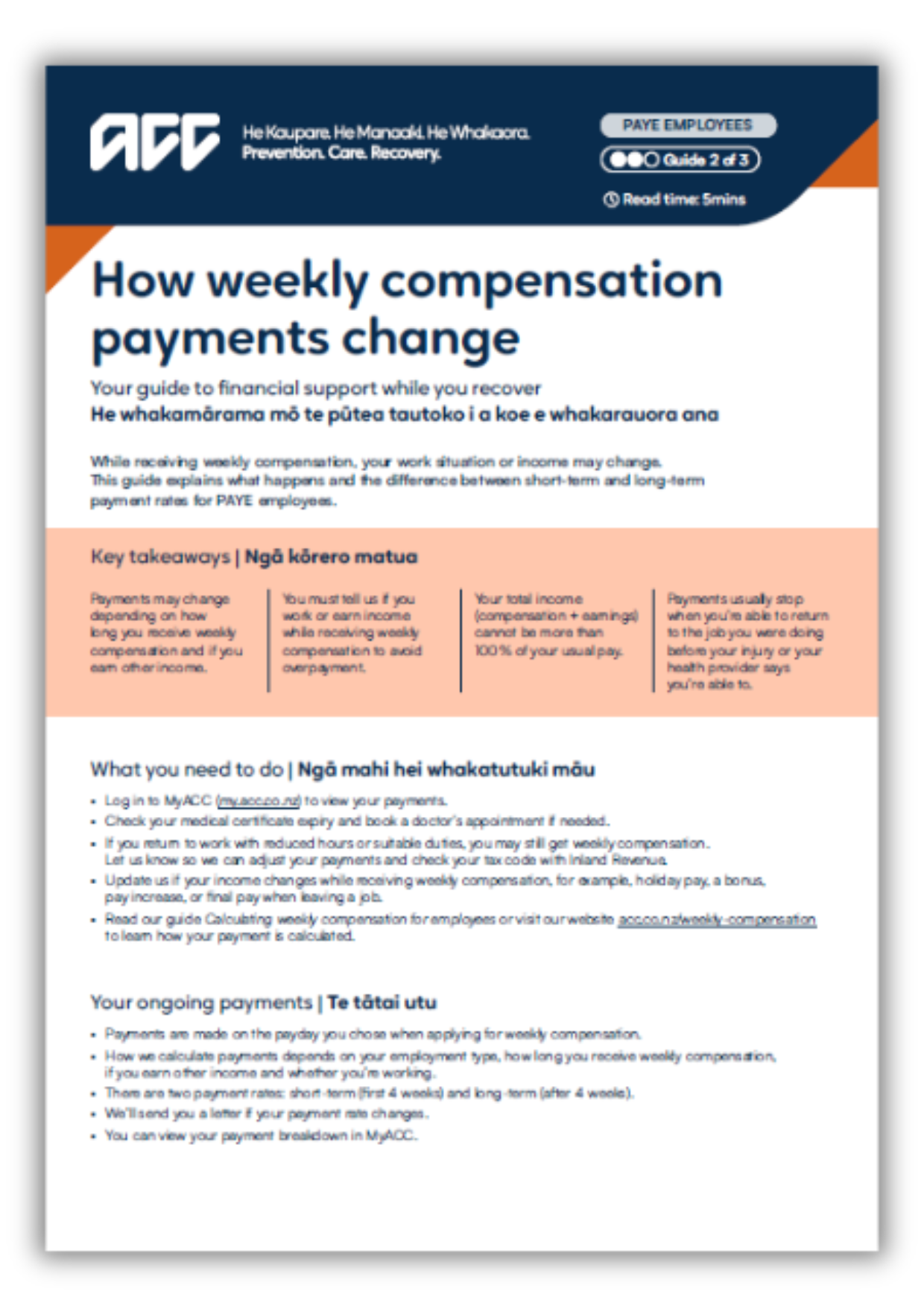
How weekly compensation payments change - for PAYE employees
This guide explains how your weekly compensation payments can change and the difference between short-term and long-term rates for PAYE employees. Download, print and share this accessible guide with whānau and friends.
Video | How weekly compensation payments change
Visual
A navy blue background displays the white ACC logo. Text appears alongside it: "He Kaupare. He Manaaki. He Whakaora. Prevention. Care. Recovery." The background wipes to a peach/pink colour. A small tag in the top right reads: PAYE employees. Large text appears on-screen: How weekly compensation payments change.
Transcript
Upbeat, gentle instrumental music plays in the background
Visual
A male presenter with a beard and curly hair tied in a bun, wearing a cream sweater, sits in an armchair in a modern office room with wood-panelled walls, a potted palm and couch in the background — there is an open laptop and mug on a wooden side table beside him. He speaks directly to the camera.
Transcript
Kia ora. There are several ways we can manaaki, or support you, in your recovery from injury. Weekly compensation isn't the same for everyone. It will vary based on your employment type and it can change over time. For the first four weeks, we'll use the short-term rate if you're a PAYE employee. That's usually 80% of your average weekly earnings in the four weeks before your injury.
Visual
The screen splits. The presenter remains on the right. The left side turns white and displays an orange icon of a dollar sign with circular arrows. Text reads: Permanent employees long-term rate. Below this, the formula appears: Income ÷ Weeks worked.
Transcript
After four weeks, the long-term rate kicks in. If you're a permanent employee, it's based on your income from your current job divided by the number of weeks worked, up to 52.
Visual
The text on the left changes to: Non-permanent employees long-term rate. The formula below changes to: Income ÷ 52 weeks.
Transcript
If you're a non-permanent employee, we average the income from all your non-permanent jobs over 52 weeks. This helps reflect your usual income more accurately if you've had casual, seasonal, or multiple jobs, if you're on a fixed-term contract with less than a year left, or if you'd given notice to leave your job before your injury.
Visual
The video cuts to a close up shot of the presenter in the office.
Transcript
If you return to work part-time or on alternative duties, you can still receive some weekly compensation. We adjust your payments so your total income doesn't go over what you earned before your injury. This adjustment is called abatement. It makes sure your earnings and weekly compensation are balanced fairly.
Visual
The screen splits again. The presenter is on the right. The left side displays a large orange icon with an exclamation mark in a circle, with the text: Important. Receiving other income? Let us know.
Transcript
It's also important to let us know if your earnings change while you're receiving weekly compensation. Like if you return to work, get a pay rise or holiday pay, or if you leave a job.
Visual
The video graphic disappears by swiping to the left. It’s still the close up shot of the presenter in the office.
Transcript
This helps avoid overpayment, which we will ask you to pay back. Payments usually stop when you fully return to the job you were doing before your injury, or when your health provider says you're ready. Keep your medical certificate up to date and check MyACC for payment details. Here's the key thing to remember: weekly compensation adjusts to match your situation, so it's fair and accurate, and we're here to help. Here’s a summary of what we’ve covered so far.
Visual
The screen switches to a graphic on a white background. On the left, ‘key takeaways’ appears above an orange pencil icon. On the right, a numbered list appears line by line:
- Payments change depending on your situation
- You can work and still get some weekly compensation
- Tell us about any income changes
- Check MyACC for payment details
Visual
The video cuts back to the presenter in the office for the closing statement.
Transcript
To learn more, visit our website. Hoki mai anō.
Visual
The screen returns to the navy blue background with the ACC logo in the top left. Large text in the centre reads: Use MyACC to apply for weekly compensation and manage your claim. Contact details appear at the bottom of the screen, in the following order: website www.acc.co.nz, email address claims@acc.co.nz, and the free call phone number 0800 101 996.
Transcript
The upbeat, gentle instrumental music fades out.
Impacts on payments
We have a short-term rate weekly compensation payment rate that applies to the first 4 weeks. It’s based on your average weekly earnings in the 4 weeks before your injury.
After 4 weeks, the long-term rate applies.
Permanent employees
The long-term rate is based on total income from your current PAYE job, divided by number of weeks worked (up to 52).
Non-permanent employees
The long-term rate is based on total income from all non-permanent PAYE jobs, divided by 52, regardless of weeks worked.
Different rules apply depending on your situation, contact us if you’re unsure.
If your payment falls around a public holiday, we try to pay you earlier. Payments can take 1 to 3 days to process depending on your bank.
If you were paid for a public holiday, but you did not work, let us know the number of hours you were paid for.
If you did work on a public holiday, let us know the hours you worked, the hourly rate, and the public holiday rate that applies, for example, time-and-a-half or double time.
When your employment ends, you'll receive your final pay, also known as termination pay. This includes all the wages you're owed, any holiday pay entitlements, and any other payments due to you. This might affect your weekly compensation payment, so please let us know if you are expecting or have received a final pay.
If you receive New Zealand Superannuation or support from Work and Income New Zealand, this may affect your weekly compensation payments. Get in touch with our team to find out more.
If you receive weekly compensation while returning to part time work and receiving wages, this means you have two sources of income. One of them will need a secondary tax code.
We recommend you contact Inland Revenue about tax codes.
If you haven't received a payment you were expecting, and need this urgently, call us.
You’ll need to provide regular medical certificates to continue receiving weekly compensation. You can do this online using MyACC or by emailing us.
Payments usually stop when you’re able to return to the job you were doing before your injury or your health provider says you’re able to. We’ll let you know if payments stop for other reasons.
If we’ve contacted you about an overpayment, here’s our internet banking details to make this payment:
- Use the one-off bill payment option
- Manually enter the following:
Bank account number – 03 0502 0287400 003
Name of account – Accident Compensation Corporation
Please enter our full account name when making an online payment. - Add these details to make sure we can track the payment back to you:
Particulars – First name and surname
Code – Debt ID number
Reference – Claim number
If you're paying from an overseas bank account:
SWIFT code - WPACNZ2W
You may also have to pay an international banking fee.
If your injury is stopping you from starting full-time work of at least 30 hours per week, we may be able to pay you for loss of earnings. You could be eligible if:
- you've turned 18
- you were injured before you turned 18, or injured after turning 18 but you've been in full-time study or training
- you can't work because of your injury for six months or more
- you're no longer in full-time study or training
- you're earning or already getting weekly compensation but it's less than what we'd pay for loss of potential earnings.
How much we can pay for loss of potential earnings
We can make weekly payments at 80% of the weekly minimum wage.
Applying for loss of potential earnings
To apply, talk to your recovery team. They’ll talk you through the process and forms needed to apply.
Apply for weekly compensation now
If you are ready to apply now, there are two ways to do this:
- Online using MyACC. Register then log in and access the application in the 'Get support' section.
- Phone our claims team.
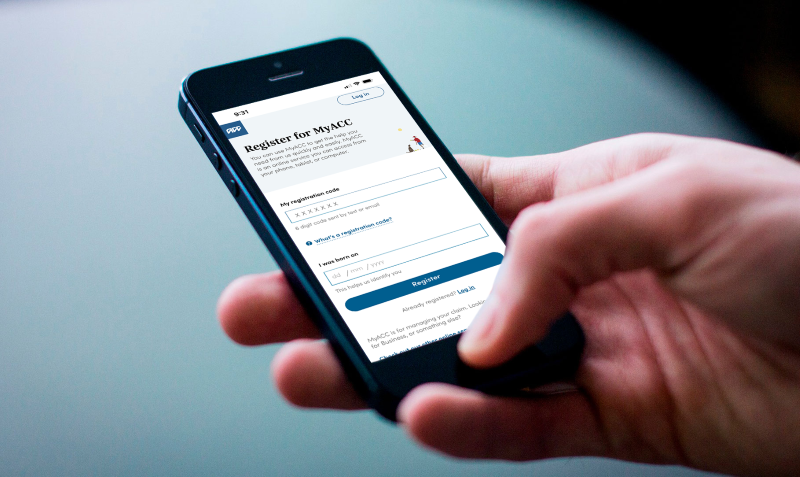
If you haven’t received a registration code by email or text, or don't want to use MyACC, contact us to apply for weekly compensation over the phone.
Phone 0800 101 996 (Monday to Friday, 8am to 6pm)
Last published: 27 November 2025