
Weekly compensation for shareholder-employees
A shareholder-employee works in a company they own shares in, including businesses with only one worker.
If you’re unable to work because of an injury, weekly compensation can help replace lost earnings. As a shareholder-employee, learn how payments are calculated, what information we may need from you, and why it’s important to tell us if you are working, receiving income or do work for your business while you're recovering.
On this page
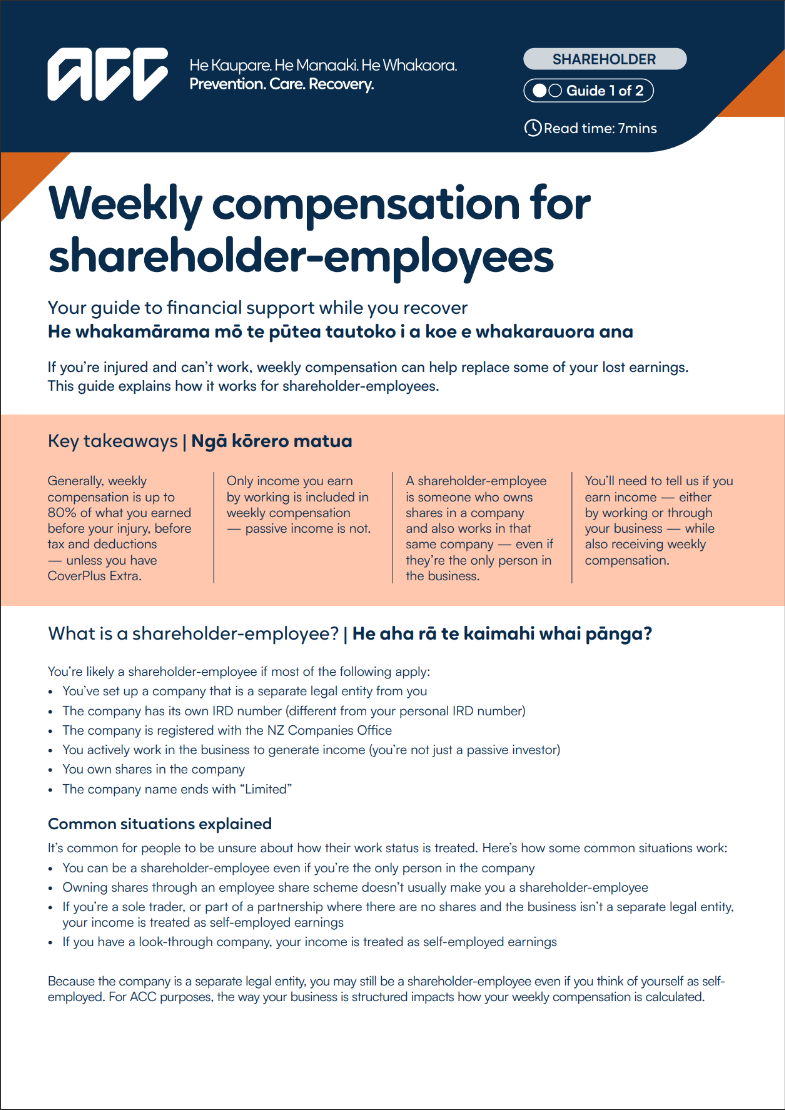
Weekly compensation for shareholder-employees guide
This guide explains how weekly compensation works if you are a shareholder-employee, steps to take and what might impact your payments. Download, print or share this guide with whānau and friends.
Video | Weekly compensation explained for shareholder-employees
Visual
A navy blue background features the white ACC logo. Text appears alongside the logo: He Kaupare. He Manaaki. He Whakaora. Prevention. Care. Recovery. The background wipes to a peach/pink colour. A small tag in the top right corner reads: shareholder-employees. Large text appears on-screen: Weekly compensation explained for shareholder-employees.
Transcript
Upbeat, gentle instrumental music plays in the background.
Visual
A male presenter with a beard and curly hair tied in a bun, wearing a cream sweater, sits in an armchair in a modern office room with wood-panelled walls, a potted palm and couch in the background — there is an open laptop and mug on a wooden side table beside him. He speaks directly to the camera.
Transcript
Kia ora! There are several ways we can manaaki — or support you — in your recovery. If you've been injured and can't work, ACC can help by replacing some of your lost income through weekly compensation.
This episode is for shareholder-employees — people who own shares in a limited company and also work there as an employee — even if they're the only person in the business. This also includes family-owned and small businesses.
Because a company is a separate legal entity, you may be a shareholder-employee even if you think of yourself as self-employed. For ACC purposes, your business structure affects how your weekly compensation is calculated.
Visual
A white panel with a rounded, angled top corner slides in from the left, partly overlapping the presenter, who remains visible on the right of the screen. A heading appears in navy text: Weekly compensation is up to 80% of your average weekly earnings. Below the heading, a pie chart appears, showing a small navy segment against a larger orange segment.
Transcript
Weekly compensation is generally up to 80% of what you earned before your injury. Tax and deductions still apply, like student loans, KiwiSaver, or child support.
If you have CoverPlus Extra, weekly compensation is based on an agreed cover amount, and the information in this video doesn't apply to you.
Visual
The video cuts back to a full shot of the presenter sitting in the chair in the office.
Transcript
Only income you earn by working is included when working out weekly compensation — for example, PAYE salary, wages, or scheduler payments. Passive income, like dividends, interest, or rental income, is not included.
Filing your tax return on time with Inland Revenue helps us calculate your payments accurately and reduces the risk of overpayment — which you'd need to pay back.
Your first weekly compensation payment covers the period from when you become eligible — usually day 8 after your injury, not the day you applied. It's paid once we've processed and approved your application. We'll let you know when this happens, and you can check MyACC for payment details.
Visual
An orange, rounded lozenge graphic appears on the left side of the screen, over the office setting, reading: Visit MyACC, my.acc.co.nz.
Transcript
Here's the key thing to remember. Weekly compensation for shareholder-employees depends on your company structure, how you report income, and how you pay levies. Contact us if you're unsure — we're here to help.
Here's a summary of what we've covered:
- A shareholder-employee owns shares in a company and also works there
- Eligibility for weekly compensation usually starts day 8 after your injury
- Filing your tax return on time means accurate and faster payments
Visual
The screen switches to a graphic on a white background, with the office setting faintly visible behind it. On the left, the heading 'Key takeaways' appears above an orange pencil icon. A vertical line divides the panel. On the right, a numbered list appears line by line, each point separated by a thin horizontal rule:
- Shareholder-employee = owns shares in a company + works there
- You're usually eligible for weekly compensation from day 8 after your injury
- Filing tax returns on time = accurate and faster payments
The video cuts back to a full shot of the presenter in the office for the closing statement.
Transcript
In the next episode, we'll look at what can affect the amount of weekly compensation you receive. To learn more, visit our website.
Hoki mai āno.
Visual
The screen returns to the navy blue background with the ACC logo in the top left. Large text in the centre reads: Use MyACC to apply for weekly compensation and manage your claim. Contact details appear at the bottom of the screen, in the following order: website www.acc.co.nz, email address claims@acc.co.nz, and the free call phone number 0800 101 996.
Transcript
The upbeat, gentle instrumental music fades out.
Key takeaways
- Generally, weekly compensation is up to 80% of what you earned before your injury, before tax and deductions — unless you have CoverPlus Extra.
- Shareholder-employee’s payments are based on liable earnings, such as PAYE wages and shareholder salary allocations. Dividends and other passive income aren't included.
- Filing your tax return helps us calculate the right payment and may help avoid delays in processing your application.
- You’ll need to tell us if you earn income — either by working or through your business — while also receiving weekly compensation.
What to expect with weekly compensation
-
File your tax return with Inland Revenue
If you haven’t, file your last year’s tax return as soon as you can. Call us on 0800 101 996 once Inland Revenue have assessed it. You can submit your weekly compensation application while this happens. -
Apply for weekly compensation
Learn how to apply for weekly compensation - Have your business and income details ready
To support your application, we may ask for:
-
- your company’s financial statements and IR4 tax returns
- your personal tax returns to confirm your earnings
- company GST returns.
If you’ve become a shareholder-employee in the past year, we may also ask for:
-
- a certificate of incorporation or accountant’s letter (for new companies)
- proof of when you started as a shareholder-employee (for existing companies).
-
-
Do you have CoverPlus Extra?
CoverPlus Extra is optional and lets you choose the level of income you want covered. If you have purchased CoverPlus Extra, check your policy to see how your weekly compensation payments will work. -
Wait for ACC approval
Once we’ve processed and approved your weekly compensation application, payments can start. -
Check your bank account
Payments go straight to your account. Your first payment covers the period from when you became eligible (usually day 8 after your injury) , so it may be different from what you expect. -
Log in to MyACC
Go to my.acc.co.nz to see past and future payments, check your claim, upload new medical certificates, log any work hours and update your details.
What can affect your payments
Your weekly compensations payments can be affected by your individual circumstances, including how your company is set up, how you pay yourself, and the earnings you've declared for ACC levies.
Video | What can affect weekly compensation payments for shareholder-employees
Visual
A navy-blue background features the white ACC logo. Text appears alongside the logo: He Kaupare. He Manaaki. He Whakaora. Prevention. Care. Recovery. The background wipes to a peach/pink colour. A small tag in the top right corner reads: shareholder-employees. Large text appears on-screen: What affects weekly compensation for shareholder-employees.
Transcript
Upbeat, gentle instrumental music plays in the background.
Visual
A male presenter with a beard and curly hair tied in a bun, wearing a cream sweater, sits in an armchair in a modern office room with wood-panelled walls, a potted palm and couch in the background — there is an open laptop and mug on a wooden side table beside him. He speaks directly to the camera.
Transcript
Kia ora!
If you're a shareholder-employee receiving weekly compensation, here's what can affect the amount you receive.
Visual
The screen switches to a graphic on a white background, with the office setting faintly visible behind it. On the left, the heading ‘What can affect your payments’ appears above an orange clipboard icon. A vertical line divides the panel. On the right, a list appears line by line, each point separated by a thin horizontal rule.
The first point appears: Your declared liable earnings.
Transcript
Your declared liable earnings.
Weekly compensation is based on earnings you've declared for ACC levies, sourced from Inland Revenue records.
PAYE salary or wages and end-of-year salary allocations count as liable earnings.
Visual
A second point appears below the first:
Filing your tax return.
Transcript
Filing your tax return.
If you haven't filed your last completed tax return, we may make estimated payments for up to three months.
Once you file, we'll reassess and adjust for any overpayment or underpayment.
Visual
A third point appears below the second:
Income differs from last financial year.
Transcript
If your income differs from last financial year.
Weekly compensation is based on up to 80% of your declared earnings from the last completed financial year, not what you're earning right now.
This means changes to your income during the year may not be reflected in your payments.
Visual
A fourth point appears below the third:
Minimum and maximum amounts.
Transcript
Minimum and maximum weekly compensation amounts.
If your compensation is below the minimum, we may be able to increase it to the full-time minimum rate, if you qualify.
These limits are set by law and updated each year. Check our website for the latest figures.
Visual
A fifth point appears below the fourth:
Earning while receiving weekly compensation.
Transcript
If you work or earn while getting weekly compensation, we adjust your payments, so your total income doesn't go over what you'd normally earn.
This adjustment is called abatement. It keeps things fair and reduces the risk of overpayment.
If you have multiple income sources, we recommend talking to Inland Revenue about a secondary tax code to make sure you pay the correct tax.
Visual
A sixth point appears below the fifth, completing the list:
CoverPlus Extra.
Transcript
And finally, if you have CoverPlus Extra, which is optional paid cover where payments are based on your agreed cover amount before tax and deductions, not your filed earnings.
Visual
The video cuts back to a full shot of the presenter sitting in the chair in the office.
Transcript
This can be useful if your income varies from year to year.
Your CoverPlus Extra policy must be active both when you're injured and while you're unable to work.
Here's the key thing to remember: payments can change based on your earnings, if you've filed your tax return, and if you've worked since your injury. Contact us if you're unsure — we're here to help.
Visual
The screen switches to a graphic on a white background, with the office setting faintly visible behind it. On the left, the heading 'Key takeaways' appears above an orange pencil icon. A vertical line divides the panel. On the right, a numbered list appears line by line, each point separated by a thin horizontal rule:
- Payments may be based on an estimate or your filed earnings.
- There are minimum and maximum amounts we can pay.
- CoverPlus Extra lets you tailor the level of income you want covered.
Transcript
Here's a summary of what we've covered:
- Payments may be based on an estimate or your filed earnings.
- There are minimum and maximum amounts we can pay.
- CoverPlus Extra lets you tailor the level of income you want covered.
Visual
The video returns to a full shot of the presenter in the office.
Transcript
In the next episode, we'll show you how weekly compensation is calculated if you're a shareholder-employee.
To learn more, visit our website.
Hoki mai āno.
Visual
The screen returns to the navy-blue background with the ACC logo in the top left. Large text in the centre reads: Use MyACC to apply for weekly compensation and manage your claim. Contact details appear at the bottom of the screen, in the following order: website www.acc.co.nz, email address claims@acc.co.nz, and the free call phone number 0800 101 996.
Transcript
The upbeat, gentle instrumental music fades out.
The earnings you've declared
Weekly compensation is based on your liable earnings, which are the earnings you've declared to Inland Revenue and used to calculate your ACC levies. These may include:
- PAYE salary and wages
- shareholder salary allocations
- schedular payments.
Passive income isn't included because they aren't earned from the work you personally do. This includes:
- dividends
- rental income
- interest
- capital gains
- trust distributions
If you receive most of your income as dividends and only a small amount as shareholder salary or PAYE wages, your weekly compensation may be lower than expected because dividends aren't included in the calculation.
Your most recent tax year
Weekly compensation is usually based on the earnings declared in your most recently completed tax year, not necessarily the income you're earning right now.
This means recent changes in your income may not be reflected in your payments until you've filed your tax return with Inland Revenue.
CoverPlus Extra
If you have CoverPlus Extra, your weekly compensation is based on your agreed cover amount rather than your filed earnings.
Your situation
Your payments may also be affected by:
- how long you've been working in your current role
- whether you've taken previous periods of time off work
- whether you've filed your most recent tax return
- whether you've received a shareholder salary allocation for your latest tax year.
If you haven't filed your most recent tax return, we may be able to make interim or estimated payments while your earnings information is being finalised. Contact us to discuss your options.
If your income changes
It's important to tell us as soon as possible if you:
- return to work full-time or part-time
- change your working hours
- start or leave a job
- do unpaid work in your business
- receive income or benefits while you're recovering.
You may still be able to receive weekly compensation if you're working reduced hours or suitable duties. We'll use this information to adjust your payments and help reduce the risk of overpayments
Calculating your payments
The way your business is structured impacts how your weekly compensation is calculated. Shareholder-employees generally fall into one of the following categories:
If you receive regular shareholder wages through PAYE, your weekly compensation is usually based on the PAYE wages you earned before your injury.
f you don't receive shareholder PAYE wages, your weekly compensation is usually based on your shareholder salary from your most recent completed tax year, plus any employee income earned in the 52 weeks before your injury.
If you receive both shareholder PAYE wages and end-of-year shareholder salary allocations, we usually combine these earnings when calculating your weekly compensation. If using only your PAYE earnings would result in a higher payment, we'll use that calculation instead
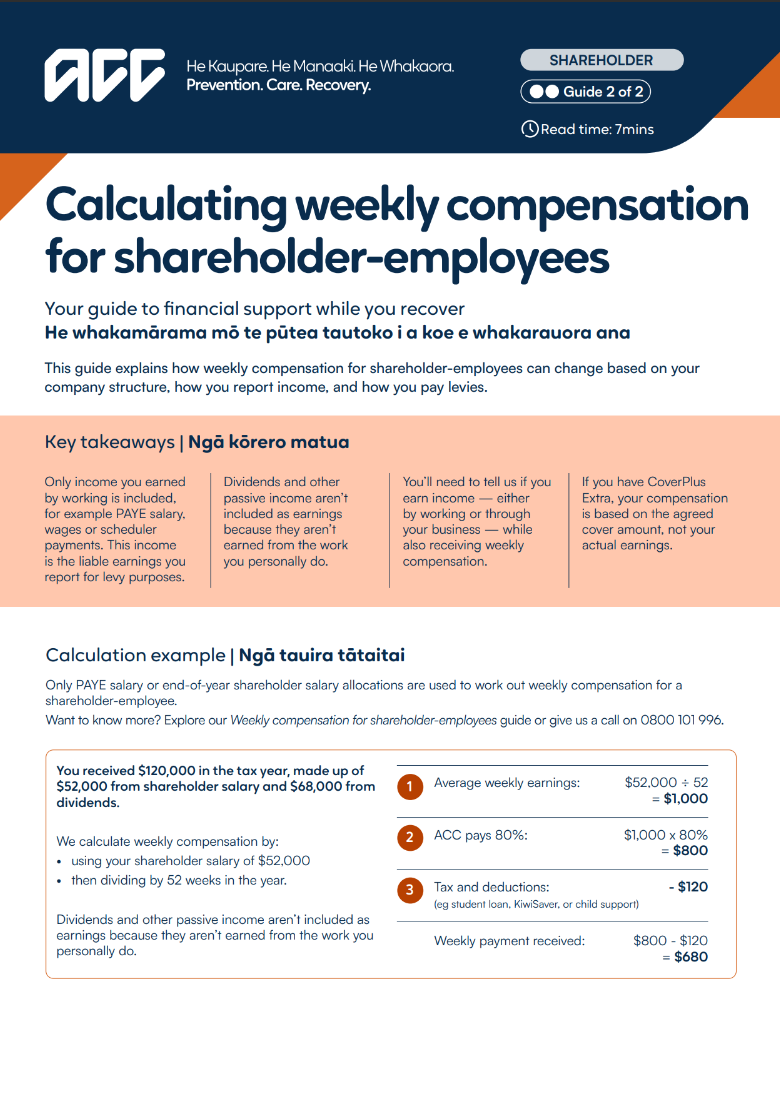
Calculating weekly compensation for shareholder-employees guide
This guide explains how weekly compensation for shareholder-employees can change based on your company structure, how you report income, and how you pay levies. Download, print or share this guide with whānau and friends.
Video | Calculating weekly compensation for shareholder-employees
Visual
A navy-blue background features the white ACC logo, centred on screen. Text appears alongside the logo: He Kaupare. He Manaaki. He Whakaora. Prevention. Care. Recovery. The background wipes to a peach/pink colour. A small tag in the top right corner reads: shareholder-employees. Large text appears on-screen: Calculating weekly compensation for shareholder-employees.
Transcript
Upbeat, gentle instrumental music plays in the background.
Visual
A male presenter with a beard and curly hair tied in a bun, wearing a cream sweater, sits in an armchair in a modern office setting. A wooden side table with an open laptop and mug sits beside him. He speaks directly to the camera.
Transcript
Kia ora!
In this episode, we'll explain how weekly compensation might be calculated for a shareholder-employee.
There are different ways payments are worked out, depending on your company structure, how you report income, and how you pay levies.
Tax and other deductions also apply to weekly compensation payments.
Visual
A white panel with a rounded, angled top corner slides in from the left, with the office setting faintly visible behind it. An orange circular icon with an exclamation mark appears at the top, followed by the heading 'Important' in orange text. Below it, navy text reads: Receiving other income? Let us know.
Transcript
You can still receive some weekly compensation if you're working reduced hours or different work while you recover.
We need to know how much you're working so we can adjust your payments to reduce the risk of overpayment.
This is called abatement and makes sure what you earn is fair and consistent.
Log your work details in MyACC or call us.
Visual
The video cuts back to a full shot of the presenter in the office.
Transcript
Shareholder-employees generally fall into three categories.
Visual
A white panel with a rounded, angled top corner slides in from the left, with the office setting faintly visible behind it. On the left, the heading 'Shareholder-employee categories' appears above an orange clipboard icon. A vertical line divides the panel. On the right, a list appears line by line as each is discussed, with a thin horizontal rule separating each new point:
PAYE shareholder-employees
Transcript
PAYE shareholder-employees — your weekly compensation payments are based on the PAYE wages you earned before your injury stopped you from working.
Visual
A second point appears below the first:
Tax year shareholder-employees
Transcript
Tax year shareholder-employees — your weekly compensation payments are based on your shareholder salary from your most recent tax year, plus any employee income you earned in the 52 weeks before your injury.
Visual
A third point appears below the second, completing the list:
Shareholder-employees with mixed earnings
Transcript
If you're a shareholder-employee with mixed earnings, we'll add together shareholder PAYE and end of year shareholder allocations to work out your payment amounts.
Visual
The graphic changes to a calculation example. On the left, under the heading 'Example', orange text reads: Total tax year earnings of $120,000. Below it: Made up of: Shareholder salary = $52,000. Dividends = $68,000. An orange circular icon with a dollar sign appears beneath this text. On the right, a table sets out the calculation steps, each row highlighting in turn as it's explained:
- Earnings of $52,000 ÷ 52 weeks = $1,000
- ACC pays 80% = $800
- Minus tax and deductions − $200
A final row, shaded navy, reads: Payment received = $600.
Transcript
Let's look at a quick calculation example. You received $120,000 in the tax year, made up of $52,000 from shareholder salary and $68,000 from dividends.
We calculate weekly compensation by using your shareholder salary of $52,000, then dividing it by 52 weeks in the year.
Visual
The video cuts back to a full shot of the presenter in the office.
Transcript
Here's a key thing to remember: dividends and other passive income aren't included as earnings because they aren't earned from the work you personally do.
Here's a summary of what we've covered.
Visual
The screen switches to a graphic on a white background, with the office setting faintly visible behind it. On the left, the heading 'Key takeaways' appears above an orange pencil icon. A vertical line divides the panel. On the right, a numbered list appears line by line, each point separated by a thin horizontal rule:
- There are different calculations depending on your situation
- Passive income is not included as earnings
- You can work and still receive some weekly compensation
- Tell us about any work or income changes so we can adjust payments
Transcript
Instrumental music continues while the key takeaways are shown on screen.
Visual
The video cuts back to a full shot of the presenter in the office for the closing statement.
Transcript
Thanks for watching! For more details on weekly compensation for shareholder-employees, visit our website.
Haere rā.
Visual
The screen cuts to the navy-blue background with the ACC logo in the top left. Large text in the centre reads: Use MyACC to apply for weekly compensation and manage your claim. Contact details appear at the bottom of the screen, in the following order: website www.acc.co.nz, email address claims@acc.co.nz, and the free call phone number 0800 101 996.
Transcript
The upbeat, gentle instrumental music fades out.
Calculation example
The following examples are for guidance. Actual payments depend on your situation.
| You received $120,000 in the tax year, made up of $52,000 from shareholder salary and $68,000 from dividends. We calculate weekly compensation by: • using your shareholder salary of $52,000 • then dividing by 52 weeks in the year. Dividends and other passive income aren’t included as earnings because they aren’t earned from the work you personally do. |
|
|---|---|
| 1. Average weekly earnings (before tax and deductions): $52,000 ÷ 52 | = $1,000 |
| 2. We will pay 80% of this amount: $1,000 x 80% | = $800 |
| 3. Minus any tax and deductions (amounts will vary for each individual) |
- $120 |
| Your weekly compensation payment after tax and deductions | = $680 |
Last published: 1 September 2026